Posts

Review: Complex Adaptive Systems: An Introduction to Computational Models of Social Life

Image
Complex Adaptive Systems: An Introduction to Computational Models of Social Life by John H. Miller My rating: 4 of 5 stars A thought-provoking introductory exploration to modeling social systems, covering ideas for rule-based agents within a variety of rule-based systems, moving onto evolutionary-like automata and organization of agents to solve problems. Underlying some of the ideas, one could see references to deeper concepts, e.g., nonlinearity, attractors, emergence, and complexity, none of which was explained explicitly. At times, I did find the writing tedious, as some ideas were too obvious to spend time detailing, but overall, a well-written easy to digest text. View all my reviews

My Most Popular Posts of 2017

Image
Although I've made many posts on my Data Analytics Workouts site, some generated more interest than others - nothing here was virally popular - and below are a handful of the most popular, sorted in descending order of views: Charting Correlation Matrices in R (877) Neural Networks (Part 4 of 4) - R Packages and Resources (507) Performance Improvements in R: Vectorization & Memoisation (322) Naive Bayes on Political Outcome Based on State-level Big Five Assessment (263) Decision Trees on Political Outcome Based on State-level Big Five Assessment (262) F# is Part of Microsoft's Data Science Workloads (223) Logistic Regression on Stock Data using Google and SPY (SPDR S&P 500) (196) Using Visual Studio Team Services for Personal Development (194) Microsoft Azure Notebooks - Live code - F#, R, and Python (186) Efficient R Programming - A Quick Review (178) Patents Per Capita and Hofstede's Cultural Dimensions (167) Comparing Performance in R Usin...

Software engineers will be obsolete by 2060

In response to an article on Medium, Software engineers will be obsolete by 2060 , I responded with the following : Interesting article on The Economist titled Automation on Automation Angst, http://www.economist.com/node/21661017, that looks at several publications that look at the historical effects of automation, and although there is always a fear of being replaced, ultimately more jobs are created than destroyed. Software engineers disappear? So what! There will be other jobs, with different titles, and in the interim, the more people use tech, the more there will be a need for software engineers. Because of this, a person asked for my opinion on maintaining their career as a .NET developer, to which I responded : Although I am a .NET developer as well, I focus on expanding my project management and leadership skills, as well as developing skills in AI/ML. Rather than bore with all the details of my background, here is what I think: You should develop your skills in AI/ML,...

Using Visual Studio Team Services for Personal Development

Image
Overview Microsoft provides free access to its online Visual Studio Team Services (VSTS) , and for some time I've been using the service, I've wanted to restructure my code hierarchy, and recent changes in my work environment, automated build and deployment using Octopus, nudged me to finally take the task on, so in the past few weeks I've: Restructured my Code library into one big project with sub-projects for Development, Websites, and Work Developed my Work hierarchy of Epics, Features, Stories and Tasks, along with queries and sprint boards Automated all of my builds via check-in, adding extensions to evaluate code and build quality Developed a dashboard to oversee the status of work Code Library I was frustrated with the limitations of working with my code library, and after reading opinions on best practices, I settled on one big project for my code, which I assumed would make it easier to manage my time and energy, and give me a global view of my individu...

Code: Pinterest as a Publication Channel for Data Analytics

Image
More as an experiment, rather an attempt at sharing code and ideas, I created a Pinterest board devoted to my personal data analytics work, done with Python, R, or F#, as well as reviews of books, and was quite surprised with the result. The graphics could do with optimization, but otherwise...

Deep Learning and Toolkits

Image
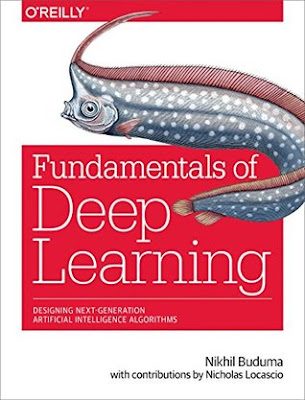
As part of reading Fundamentals of Deep Learning: Designing Next-Generation Machine Intelligence Algorithms by Nikhil Buduma , I was expecting to work through some of the code examples with my own data, and for the examples, it recommended TensorFlow , which brings up competing alternatives, a primary one being Microsoft Cognitive Toolkit . Over the next few weeks, I will start exploring both in Python, as well as publishing some of the related work. A minor note, the darksigma/Fundamentals-of-Deep-Learning-Book: Code companion to the O'Reilly "Fundamentals of Deep Learning" book is available on GitHub.

Principal Component Analysis (PCA) on Stock Returns in R

Image
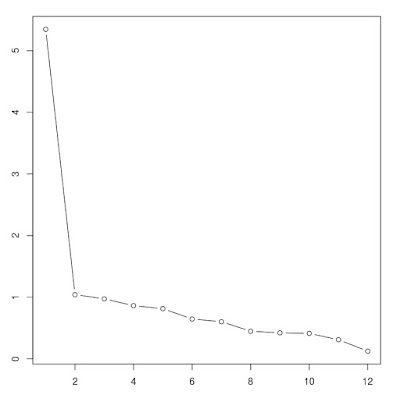
Principal Component Analysis Principal Component Analysis is a statistical process that distills measurement variation into vectors with greater ability to predict outcomes utilizing a process of scaling, covariance, and eigendecomposition. MS Azure Notebook The work for this is done in the following notebook, Principal Component Analysis (PCA) on Stock Returns in R , with detailed code, output, and charts. An outline of the notebook contents are below. Overview of Demonstration Supporting Material Pluralsight Explained Visually Wikipedia Load Data: Format Data & Sort Prep Data: Create Returns Generate Principal Components Eigen Decomposition and Scree Plot Create Principal Components Analysis FVX using PCA versus Logistic Regression Alternative Libraries: Psych for the Social Sciences