Posts

Showing posts with the label matrices

Code: Pinterest as a Publication Channel for Data Analytics

Image
More as an experiment, rather an attempt at sharing code and ideas, I created a Pinterest board devoted to my personal data analytics work, done with Python, R, or F#, as well as reviews of books, and was quite surprised with the result. The graphics could do with optimization, but otherwise...

Value-at-Risk (VaR) Calculator Class in Python

Image
As part of my self-development, I wanted to rework a script, which are typically one-offs, and turn it into a reusable component, although there are existing packages for VaR. As such, this is currently a work in progress. This code is a Python-based class for VaR calculations , and for those unfamiliar with VaR, it is an acronym for value at risk, the worst case loss in a period for a particular probability. It is a reworking of prior work with scripted VaR calculations , implementing various high-level good practices, e.g., hiding/encapsulation, do-not-repeat-yourself (DRY), dependency injection, etc. Features: Requires data frame of stock returns, factor returns, and stock weights Expose a method to calculate and return a single VaR number for different variance types Expose a method to calculate and return an array of VaR values by confidence level Expose a method to calculate and plot an array of VaR values by confidence level Still to do: Dynamic factor usage Note...

Calculating Value at Risk (VaR) with Python or R

Image
The following modules linked below are based on a Pluralsight course, Understanding and Applying Financial Risk Modeling Techniques , and while the code itself is nearly verbatim, this is mostly for my own development, working through the peculiarities of Value at Risk (VaR) in both R and Python, and adding commentary as needed. The general outline of this process is as follows: Load and clean Data Calculate returns Calculate historical variance Calculate systemic, idiosyncratic, and total variance Develop a range of stress variants, e.g. scenario-based possibilities Calculate VaR as the worst case loss in a period for a particular probability The modules: In R: Financial Risk - Calculating Value At Risk (VaR) with R In Python: Financial Risk - Calculating Value At Risk (VaR) with Python

Basic Three Layer Neural Network in Python

Image
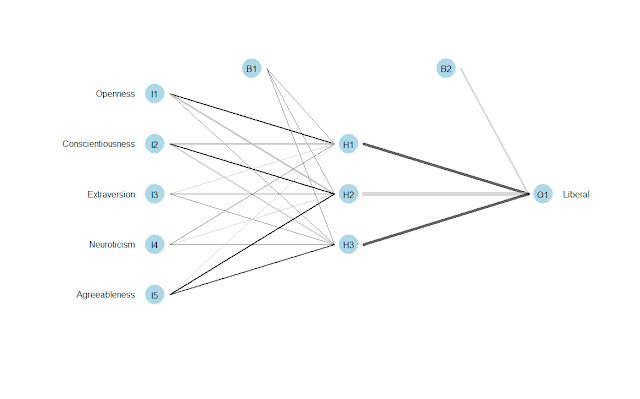
Introduction As part of understanding neural networks I was reading Make Your Own Neural Network by Tariq Rashid. The book itself can be painful to work through, as it is written for a novice, not just in algorithms and data analysis, but also in programming. Although the code is a verbatim transcription from the text (see Source section), I published it to better understand how neural networks are designed, made easy by the use of a Jupyter Notebook, not to present this as my own work, although I do hope that this helps others develop their talents with data analytics.  Github Source:  AzureNotebooks/Basic Three Layer Neural Network in Python.ipynb at master · JamesIgoe/AzureNotebooks (github.com) Overview The code itself develops as follows: Constructor set number of nodes in each input, hidden, output layer link weight matrices, wih and who weights inside the arrays are w_i_j, where link is from node i to node j in the next layer set learning rate activat...