Posts

Showing posts with the label dictionary

Computational Statistics in Python: Exercises
Image
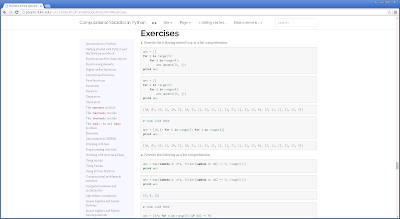
I worked through Exercises section of the Computational Statistics in Python tutorial . Below are the results, with some variations i generated to get a better understanding of the solutions: # Exercises """http://people.duke.edu/~ccc14/sta-663/FunctionsSolutions.html#exercises""" """1. Rewrite the following nested loop as a list comprehension ans = [] for i in range(3): for j in range(4): ans.append((i, j)) print ans""" arr = [(i,j) for i in range(3) for j in range(4)] arr """2. Rewrite the following as a list comprehension ans = map(lambda x: x*x, filter(lambda x: x%2 == 0, range(5))) print ans""" arr = [x**2 for x in range(5) if x%2 == 0] """3. Convert the function below into a pure function with no global variables or side effects x = 5 def f(alist): for i in r...

Exercises: Computational Statistics in Python - Introduction to Python

To prepare for further exploration in data analytics, and give myself some time to absorb R, I decided to work in Python for a while. For this, I worked through Computational Statistics in Python module Introduction to Python . These are some of the code produced to solve the exercises: # Tutorial Answers """http://people.duke.edu/~ccc14/sta-663/IntroductionToPythonSolutions.html""" """1. Solve the FizzBuzz problem “Write a program that prints the numbers from 1 to 100. But for multiples of three print “Fizz” instead of the number and for the multiples of five print “Buzz”. For numbers which are multiples of both three and five print “FizzBuzz”.""" def fizz_buzz(begin, end): """Write a program that prints the numbers from 1 to 100. But for multiples of three print “Fizz” instead of the number and for the multiples of five print “Buzz”. For numbers which are multi...