Posts

Showing posts with the label neuralnet

Neural Networks (Part 4 of 4) - R Packages and Resources
Image
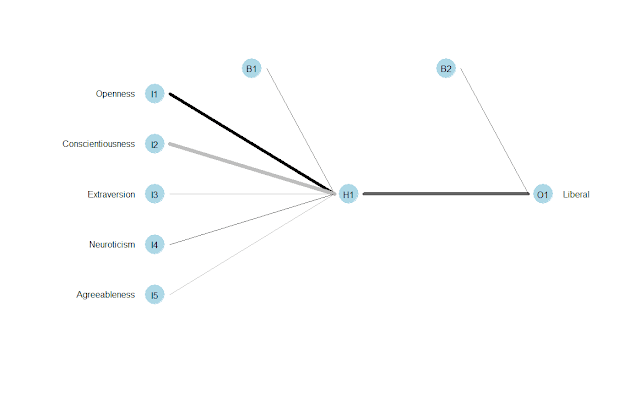
While developing these demonstrations in logistic regression and neural networks, I used and discovered some interesting methods and techniques: Better Methods A few useful commands and packages...: update.packages() for updating installed packages in one easy action as.formula() for creating a formula that I can reuse and update in one action across all my code sections View() for looking at data frames fourfoldplot() for plotting confusion matrices neuralnet for developing neural networks caret , used with nnet , to create predictive model plotnet() in NeuralNetTools, for creating attractive neural network models Resources that I used or that I would like to explore... MS Azure Notebooks , for working online with Python, R, and F#, all part of MS's data workflows Efficient R Programming , that seems to have many good tips on working with R Data Mining Algorithms in SSAS, Excel, and R , showing various algorithms in each technology R Documentation , a ...

Neural Networks in R (Part 1 of 4) - Logistic Regression and neuralnet on State 'Personality' and Political Outcomes

Image
This is an example of neural networks using the neuralnet package on one of my sample data sets, walking through a Pluralsight training series, Data Mining Algorithms in SSAS, Excel, and R . In terms of results, the regression primarily predicts voter leanings based on five (5) traits, openness, conscientiousness, extraversion, agreeableness, and neuroticism, although only the first two (2) traits have a significant impact. Logistic regression is about 85% predictive, and slightly better at predicting Red states over its ability in predicting Blue states. [1] "Logistic Regression (All) - Correct (%) = 0.854166666666667" [1] "Logistic Regression (Red) - Correct (%) = 0.892857142857143" [1] "Logistic Regression (Blue) - Correct (%) = 0.8" For the neuralnet package, I created a loop to vary the hidden layers and the number of repetitions, since this is such a small number of records. This is obviously much less predictive than logistic regressi...