Posts

Showing posts with the label function

Basic Three Layer Neural Network in Python
Image
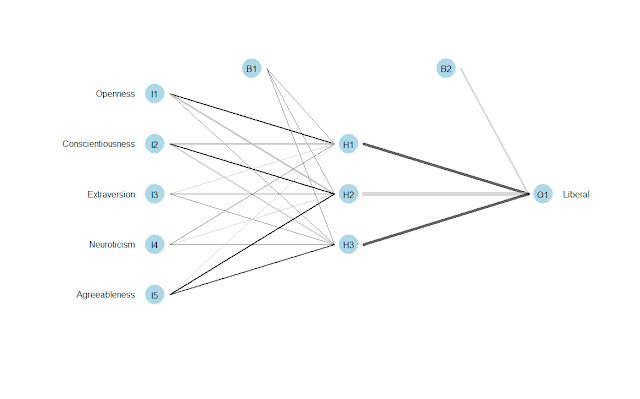
Introduction As part of understanding neural networks I was reading Make Your Own Neural Network by Tariq Rashid. The book itself can be painful to work through, as it is written for a novice, not just in algorithms and data analysis, but also in programming. Although the code is a verbatim transcription from the text (see Source section), I published it to better understand how neural networks are designed, made easy by the use of a Jupyter Notebook, not to present this as my own work, although I do hope that this helps others develop their talents with data analytics.  Github Source:  AzureNotebooks/Basic Three Layer Neural Network in Python.ipynb at master · JamesIgoe/AzureNotebooks (github.com) Overview The code itself develops as follows: Constructor set number of nodes in each input, hidden, output layer link weight matrices, wih and who weights inside the arrays are w_i_j, where link is from node i to node j in the next layer set learning rate activat...

Performance Improvements in R: Vectorization & Memoisation

Image
Full of potential coding improvements, Efficient R Programming: A Practical Guide to Smarter Programming , the book makes two suggestions that are notable. Vectorization, explained here and here , and memoisation , caching prior results albeit with additional memory use, were relevant and significant. What follows is a demonstration of the speed improvements that might be achieved using these concepts. ################################ # performance # vectorization and memoization ################################ # clear memory between changes rm(list = ls()) #load memoise #install.packages('memoise') library(memoise) # create test function monte_carlo = function(N) { hits = 0 for (i in seq_len(N)) { u1 = runif(1) u2 = runif(1) if (u1 ^ 2 > u2) hits = hits + 1 } return(hits / N) } # memoise test function monte_carlo_memo <- memoise(monte_carlo) # vectorize function monte_carlo...

Functions are first class objects: Higher Order Functions

I am currently working through Computational Statistics in Python 's module Functions are first class objects , and for this - I have worked with delegates and higher order functions in other languages - I put together this example to better grasp higher order functions in Python: def power_function(num, power): """power of num.""" return num**power def add_function(num, more): """sum of num.""" return num+more def runFunction(fx, x, y): return fx(x,y) num = 2 powers = range(0,64) arrPower = list(map(lambda x: runFunction(power_function, num, x), powers)) arrAdd = list(map(lambda x: runFunction(add_function, num, x), powers)) arrPower arrAdd