Posts

Showing posts with the label returns

Principal Component Analysis (PCA) on Stock Returns in R
Image
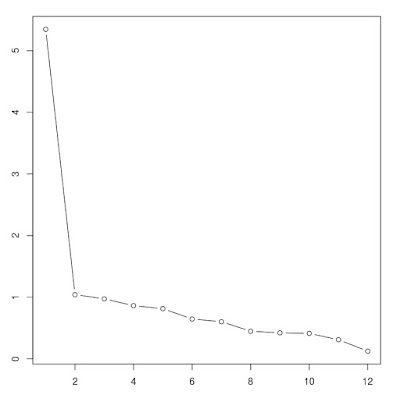
Principal Component Analysis Principal Component Analysis is a statistical process that distills measurement variation into vectors with greater ability to predict outcomes utilizing a process of scaling, covariance, and eigendecomposition. MS Azure Notebook The work for this is done in the following notebook, Principal Component Analysis (PCA) on Stock Returns in R , with detailed code, output, and charts. An outline of the notebook contents are below. Overview of Demonstration Supporting Material Pluralsight Explained Visually Wikipedia Load Data: Format Data & Sort Prep Data: Create Returns Generate Principal Components Eigen Decomposition and Scree Plot Create Principal Components Analysis FVX using PCA versus Logistic Regression Alternative Libraries: Psych for the Social Sciences

Value-at-Risk (VaR) Calculator Class in Python

Image
As part of my self-development, I wanted to rework a script, which are typically one-offs, and turn it into a reusable component, although there are existing packages for VaR. As such, this is currently a work in progress. This code is a Python-based class for VaR calculations , and for those unfamiliar with VaR, it is an acronym for value at risk, the worst case loss in a period for a particular probability. It is a reworking of prior work with scripted VaR calculations , implementing various high-level good practices, e.g., hiding/encapsulation, do-not-repeat-yourself (DRY), dependency injection, etc. Features: Requires data frame of stock returns, factor returns, and stock weights Expose a method to calculate and return a single VaR number for different variance types Expose a method to calculate and return an array of VaR values by confidence level Expose a method to calculate and plot an array of VaR values by confidence level Still to do: Dynamic factor usage Note...

Calculating Value at Risk (VaR) with Python or R

Image
The following modules linked below are based on a Pluralsight course, Understanding and Applying Financial Risk Modeling Techniques , and while the code itself is nearly verbatim, this is mostly for my own development, working through the peculiarities of Value at Risk (VaR) in both R and Python, and adding commentary as needed. The general outline of this process is as follows: Load and clean Data Calculate returns Calculate historical variance Calculate systemic, idiosyncratic, and total variance Develop a range of stress variants, e.g. scenario-based possibilities Calculate VaR as the worst case loss in a period for a particular probability The modules: In R: Financial Risk - Calculating Value At Risk (VaR) with R In Python: Financial Risk - Calculating Value At Risk (VaR) with Python